Intro
Design
Airframe
Hardware
Software
Testing
Launch 5
Glossary
Links
Contact
Digesting the First Launch
| Some Instrument Data |
| (Note that the gaps in the graphs are due to the ground station losing battery power for a few minutes during the flight, so telemetry for that period wasn't received) |
|
|
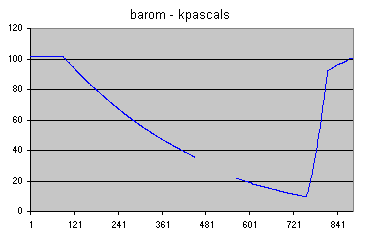
(Note the x-axis is scaled in status-telemetry data points above, which are 4 seconds apart)
|
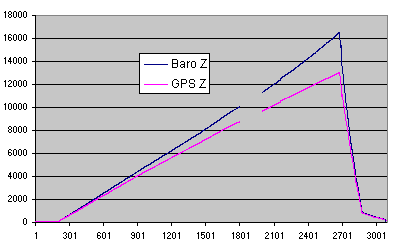
The glider uses an algorithm to get altitude from barometric pressure that is based on the ICAO standard atmosphere model. This algorithm was verified independently against government weather sonde data for the same day, and found to be correct. But the baro pressure itself seemed to be in error by about 3% over its full scale of 110 kpasc. This is simply a calibration error, which was corrected. (Note the x-axis above is scaled in seconds) |
|
|
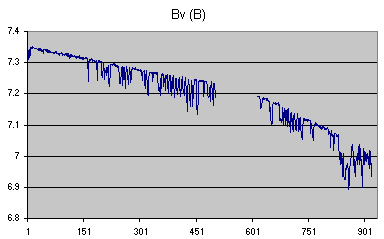
The down-spikes appear to be caused by the intermittent load of using the cameras, and longish jpeg downloads that use the data radio. (Note the x-axis above is scaled in status-telemetry data points, which are 4 seconds apart) |
|
|
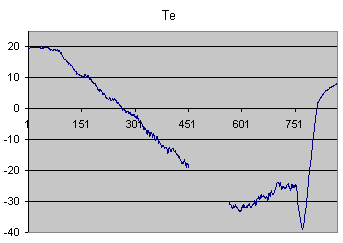
When compared to the ICAO standard atmosphere temperature for 43,000 feet, or government weathersonde temperatures from the same day and altitude, the Te looks to be about 15 degrees Celsius high for the higher altitudes. In other words, it's measuring the fuselage skin temperature more than the external temperature. To try to fix this problem, a small metal fin was attached to the external temperature sensor for the next flight. (Note the x-axis above is scaled in status-telemetry data points, which are 4 seconds apart) |
|
|
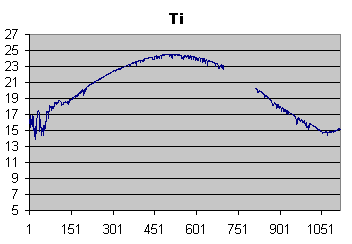
Nice internal temperature data here, which is roughly corroborated by the temps given by the GPS, and the bus-board's temperature sensor (not shown). The range is within the design tolerance, and consistent. This also shows the fuselage insulation is working significantly better than in ground test of its effectiveness - matching the design goal, in fact! (Note the x-axis above is scaled in status-telemetry data points, which are 4 seconds apart)
|
| What Didn't It Gain Control and Pull Out? |
|
The most frustrating thing about this launch is that despite the fact
the instruments all gave data that was if not perfectly accurate, at
least reliable and consistent, it's impossible to tell for certain
why the autopilot didn't gain control after release from the balloon.
But enough is known to at least eliminate some causes from suspicion,
and narrow it down.
After release, the "expert system" level autopilot detected it was falling, and switched into trim-out mode immediately. That mode has no other goal then to establish good trim and a steady ground track. The data during the initial descent is good-quality, and shows the glider dove straight down, with some movement relative to the ground shown by the GPS. That movement is consistent with the glider diving downwards with very little horizontal speed relative to the air, i.e., simply drifting downwind as it fell. The GPS velocity data also shows it accelerated at about 1 g downwards, but shows very little horizontal acceleration. Yet, based on the pitot-airspeed data, which fits well with the ambient air pressure and descent speed at any given second, the wings failed at about the speed for 7g's load on the wings at normal pitch trim (assuming the trim was normal). When the wings failed is obvious from the instant loss of GPS lock and pitot-based data. Seven G's is about their maximum design loading, so this is a failure to control rather than a failure of the wings. The airspeed at this point had built up to a level far too fast for the altitude. The physical evidence from the wings - the bent-up left wing's joiner tube - also shows that the wings failed in a positive G overloading. This appears to have been followed by a skewed snap roll to the right (due to losing the right wing?), which twisted the remaining left wing and caused the fin to fail to the left. So at first glance, it seems the wings were lifting, which seems to say it wasn't a problem of too-low a pitch trim. The telemetry also gives the rudder position the autopilot used at each of those critical seconds - and a human pilot, given the nav data available, could have done no better. The autopilot did exactly what it was programmed to do at each point to trim the flight path straight. There are two likely possibilities:
Without second-by-second G-loading and roll-rate information, or a visual record, none of which are available, there is no way to tell the difference between these potential causes. The only thing to do is try and attack all possible causes. On the bright side, there is every indication that the performance of the airframe, software, and hardware all met or came very close to their individual design specs. The problem, whatever it was, is most likely at the specification or high level design level, rather than a component failure.
|
| Solutions for Next Time |
|
| New Hardware, Software, and Airframe Mods |
|
A new set of wings were built, out of foam-cores with vacuum
bagged fibreglass skins. They were also designed to meet the original 9g ultimate
load, which helps with stiffness, although the extra G capacity is
probably pointless. Although the wings are heavier, carbon-fiber rather than steel
wing
joiner tubes offset this.
A small sensor board was constructed that senses up to +-16 G in the Z-axis, as well as a roll-rate using a ceramic/piezo gyro. So, it should be possible to get good roll-feedback control from a low-cost gyro, even if it isn't up to the quality that would be needed to do inertial-nav tricks.
|